Know the destination
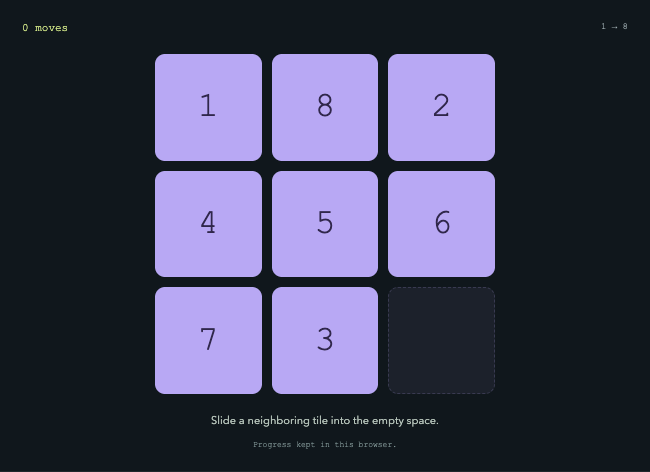
Nine Lives is an eight-tile puzzle on a three-by-three board. The finished top row is 1, 2, 3; the middle row is 4, 5, 6; and the bottom row is 7, 8, followed by the empty space. The starting arrangement is produced by legal moves from the solved board, so every new shuffle is solvable. The empty space is part of the solution, not a missing numbered tile to collect.
Move the empty space deliberately
Only a tile directly above, below, left or right of the empty space can move into it. Diagonal tiles and tiles two spaces away will not move. On a phone, tap a neighboring tile. On a keyboard, focus the game and use arrow keys to move the empty space in the selected direction. A tile consequently travels in the opposite direction. If an arrow appears to do nothing, check whether it points off the edge.
Build a small plan
Locate tile 1 and move the empty space around it so you can guide it toward the top-left corner. Then work on arranging the first row while keeping track of the space you need for the next tile. Moving a correct tile temporarily is sometimes necessary; judge the overall arrangement rather than insisting every correct tile can stay fixed immediately. A useful habit is to think two or three legal moves ahead before starting a short rotation.
Solve the remaining area
After the top row is in place, consider the remaining two rows as a smaller working area. Use rotations of the available tiles to position the middle row and finish the bottom row. Avoid endlessly reversing the same move: if the board looks unchanged after several taps, stop and choose a new route for the empty space. There is no move limit, so experimenting is allowed. A specific starting board may need a different sequence from another shuffled run.
Questions about progress
A legal move increments the move counter; an invalid tap does not solve or rearrange anything. The game declares success only when all numbered tiles and the empty space are in the final order. Your board and moves save in this browser, and Restart creates a new solvable shuffle. There is no universal one-click solution or advertised minimum-move guarantee here. If you are stuck, take a break and resume the saved arrangement rather than losing it unnecessarily.