Your ship and the finish line
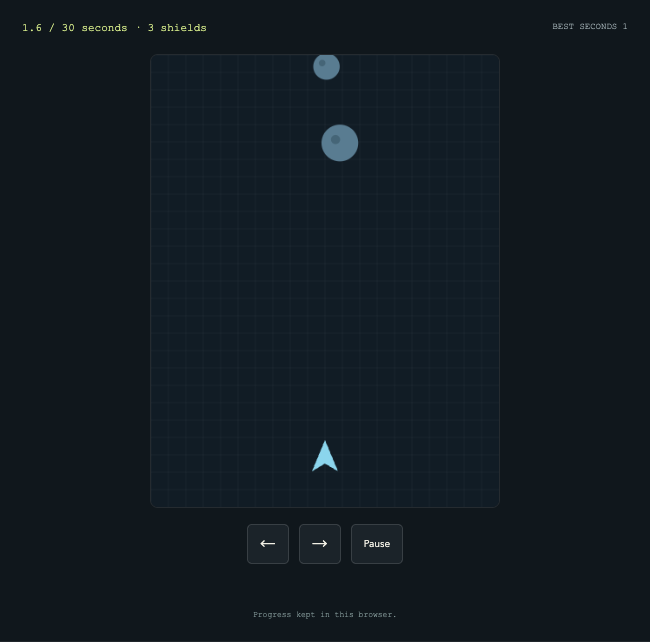
Meteor Drift asks you to survive a thirty-second meteor shower. You begin with three shields. A collision removes a shield; losing the last one ends the run. The timer and shield count in the HUD tell you how close you are to the goal. This is a survival challenge, not a shooting game: there is no weapon, ammunition upgrade or boss to defeat.
Use controlled movements
Steer with Left and Right or A and D. Touch players can hold the direction buttons or drag across the board. The ship moves horizontally near the bottom of the playing area. You do not need to cross the entire screen whenever a meteor appears. Small corrections are easier to reverse and help you remain inside a gap while the next obstacles approach.
Read the upper part of the board
Watch where meteors are coming from before they reach the ship. Identify an open corridor and move into it while there is still time. Looking only at the ship makes every avoidance feel like an emergency. If two obstacles narrow a gap, consider a neighboring wider space instead of trying to squeeze through a path that may close. The center offers room to move both ways, but staying there automatically is not a winning rule.
Recover after a collision
The brief invincibility period after a hit gives you a chance to reposition. Use it to find open space rather than assuming a shield can absorb every meteor in a cluster. Watch the updated shield count and avoid panic-driven swings from edge to edge. The game is winnable by reaching the time goal with a shield remaining. Pause with P or the on-screen button if you need a break; a paused run does not advance the survival timer.
Returning for another attempt
A finished or lost run can be restarted using the player’s Restart control. The browser stores your longest survival time, but it starts a new moving run when you return. There is no offline survival credit and no global ranking represented by that local best. If one pattern repeatedly catches you, note whether you saw the gap too late or moved farther than necessary, and adjust the next attempt accordingly.